Cardioanaesthesia Weekend
Safer anaesthetic decisions in cardiac patients


What changes in your anaesthetic plan when the patient has heart disease?
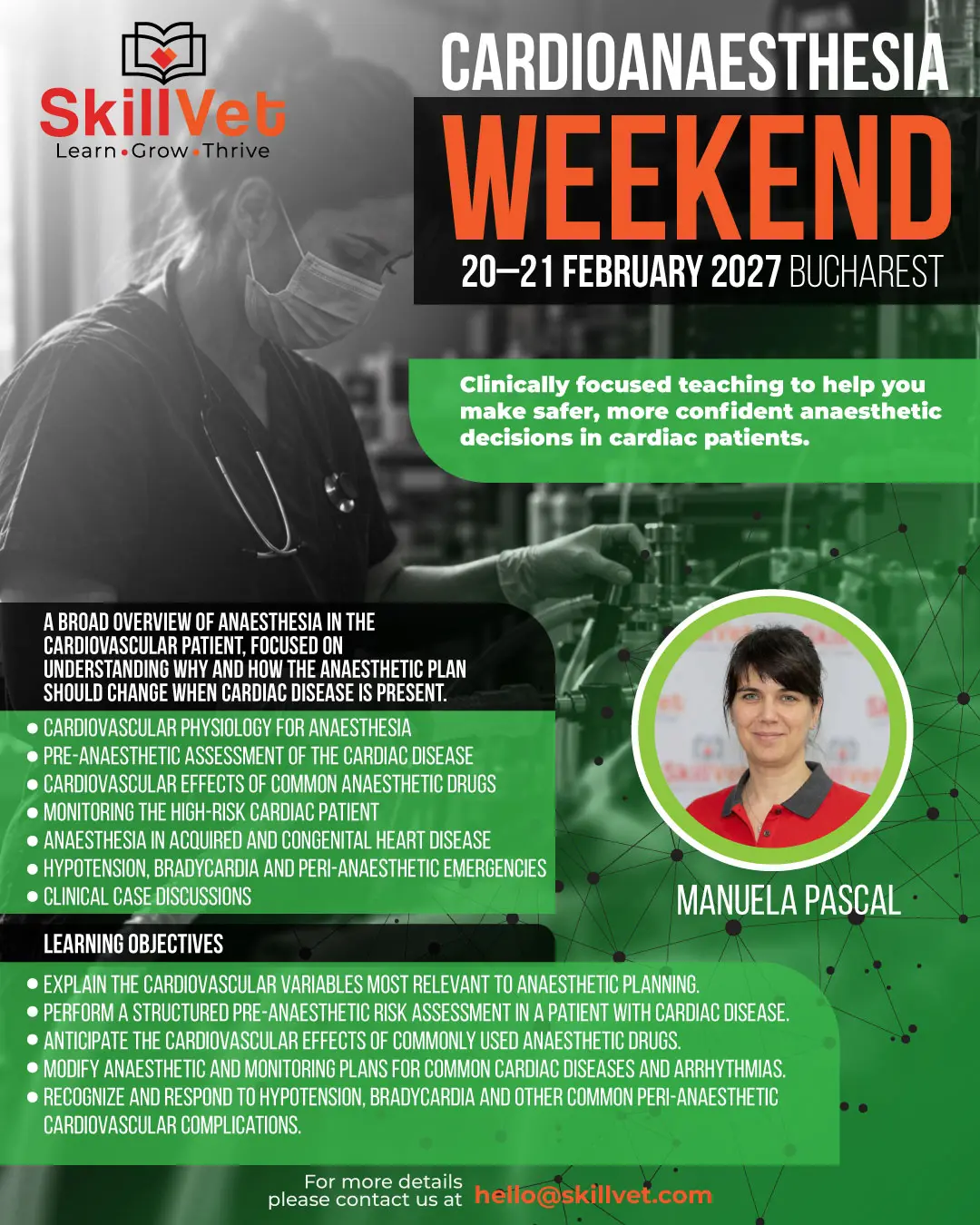
Two days of clinically focused teaching to help you make safer, more confident anaesthetic decisions in cardiac patients, with Dr. Manuela Pascal, a Diplomate of the European College of Veterinary Anaesthesia and Analgesia.
Key facts
February 20–21, 2027 · Bucharest, Romania, in person · Lecture-based, with ECGs and case discussion · Certificate of attendance · €545 early bird, €665 standard (all taxes included)
About the weekend
A patient with heart disease needs an anaesthetic. What changes in your plan? Which of the drugs you use every day change the cardiovascular picture, and how? What do you monitor, and which signals tell you early that the patient is deteriorating? Does the answer change with the disease, whether it is MMVD, cardiomyopathy, pulmonary hypertension, or a congenital lesion? And when blood pressure falls or the heart rate slows, how do you identify the mechanism and choose the right treatment?
Dr. Manuela Pascal works from cardiovascular physiology, pre-anaesthetic assessment, anaesthetic drugs, and monitoring on Saturday to disease-specific anaesthesia, complications, and clinical case discussions on Sunday. Saturday gives you the framework. Sunday applies it to specific diseases, to arrhythmias, and to the anaesthetic emergencies you need to be ready for.
The weekend is a broad overview, focused on understanding why and how the anaesthetic plan should change when cardiac disease is present. It gives you a practical conceptual framework and confidence with common presentations, rather than specialist depth. Teaching is lecture-based, with ECGs and clinical case discussion where appropriate. There are no practical sessions.
What you will be able to do
By the end of the weekend, participants will be able to:
- Explain the cardiovascular variables most relevant to anaesthetic planning
- Perform a structured pre-anaesthetic risk assessment in a patient with cardiac disease
- Anticipate the cardiovascular effects of commonly used anaesthetic drugs
- Modify anaesthetic and monitoring plans for common cardiac diseases and arrhythmias
- Recognize and respond to hypotension, bradycardia, and other common peri-anaesthetic cardiovascular complications
Weekend at a glance
Day 1: Saturday, February 20, 2027
Understanding the
cardiovascular patient
Bucharest, Romania
Saturday builds the foundation: the physiology behind the anaesthetic plan, how to assess the cardiac patient before anaesthesia, how common drugs act on the cardiovascular system, and what to monitor.
- 9:00–10:30 —
Cardiovascular Physiology
for the Anaesthetist.
Preload, afterload, contractility, blood pressure, cardiac output, and oxygen delivery: the variables most relevant to anaesthetic planning. - 11:00–12:30 —
Pre-Anaesthetic Assessment
of the Cardiac Patient.
What changes the anaesthetic plan? A structured risk assessment before anaesthesia. - 13:30–15:00 —
Anaesthetic Drugs in
Cardiac Patients.
The cardiovascular effects of common sedatives, induction agents, opioids, and inhalational agents. - 15:30–17:00 —
Monitoring the
Cardiovascular Patient Under Anaesthesia.
ECG, blood pressure, capnography, and oxygenation, and what signals early deterioration.
Day 2: Sunday, February 21, 2027
Disease-specific
anaesthesia & complications
Bucharest, Romania
Sunday turns to specific diseases and complications: acquired and congenital heart disease, arrhythmias, and anaesthetic emergencies, closing with clinical case discussions.
- 9:00–10:30 —
Anaesthesia in Acquired
Heart Disease.
MMVD, cardiomyopathy, CHF, and pulmonary hypertension, and how each changes the anaesthetic and monitoring plan. - 11:00–12:30 —
Anaesthesia in Congenital
Heart Disease & Arrhythmias.
Stenotic lesions, shunts, and rhythm disturbances. - 13:30–15:00 —
Hypotension, Bradycardia
& Other Anaesthetic Emergencies.
When blood pressure falls or the heart rate slows: identify the mechanism and choose appropriate treatment. - 15:30–17:00 —
Cardioanaesthesia Case
Discussions.
Protocol selection and management of common complications, applied to clinical cases.
Is this weekend right for you?
This weekend is for veterinarians in clinical practice who want clinically focused teaching to help them make safer, more confident anaesthetic decisions in cardiac patients.
It is a broad, clinically oriented overview. You get a practical conceptual framework for why and how the plan changes when the patient has heart disease, and confidence with the presentations you are most likely to meet, rather than specialist depth. There are no practical sessions.
Cardiovascular physiology is also part of Module 1 of the Basic Cardiology Course, which builds a broad cardiology foundation over three modules. This weekend takes that physiology into the anaesthetic plan. Arrhythmias and congenital heart disease, which Sunday covers from the anaesthetic side, are taught in greater depth in the Advanced Cardiology Masterclass, in its advanced ECG and arrhythmias weekend and its congenital heart disease weekend.
Faculty
Dr. Manuela Pascal, DVM, MSc, PhD, MRCVS, Dipl. ECVAA
EBVS-recognized Specialist in Veterinary Anaesthesia and Analgesia
You learn from a Diplomate of the European College of Veterinary Anaesthesia and Analgesia with long experience supervising interns, residents, and postgraduate veterinarians.
Dr. Manuela Pascal is an EBVS-recognized Specialist in Veterinary Anaesthesia and Analgesia (Dipl. ECVAA), currently at Dick White Referrals and serving as Honorary Secretary of the European College of Veterinary Anaesthesia and Analgesia (ECVAA).
Her career combines
specialist clinical practice, academic research, and structured postgraduate
teaching across veterinary faculties and UK referral hospitals. She has held
faculty positions at the Faculty of Veterinary Medicine in Bucharest and
clinical teaching roles at multiple UK referral and university hospitals,
including during and following her ECVAA residency training, and has extensive
experience working within teaching hospital environments.
Conclusion
Two days that take you from the physiology of the cardiac patient to the drugs, the monitoring, and the complications, and close with case discussions on protocol selection and the management of common complications. If you anaesthetize patients with cardiac disease, this weekend is built to help you do it with more confidence.
Questions about whether the weekend fits you? hello@skillvet.com
Registration fees
- Early bird: €545 (all taxes included)
- Standard: €665 (all taxes included)
What's included: two days of teaching with Dr. Manuela Pascal, course materials, access to theory lecture recordings, lunch, coffee, and water on both days, and a certificate of attendance.
Not included: accommodation, travel, and evening meals.
Romanian VAT (21%) is legally required for all participants, regardless of country of origin or VAT registration status. This is a legal obligation under EU and Romanian tax law for in-person educational events; it cannot be waived or exempted.
FAQ
Yes. Registration covers this weekend only (February 20–21, 2027). At the end, you receive a certificate of attendance.
It is a broad, clinically oriented overview of anaesthesia in the cardiovascular patient. It gives you a practical conceptual framework for why and how the anaesthetic plan changes when cardiac disease is present, and confidence with common presentations, rather than specialist depth. There are no practical sessions.
The Basic Cardiology Course is a separate three-module course that builds a broad clinical cardiology foundation, and its Module 1 includes cardiovascular physiology. The Cardioanaesthesia Weekend is a stand-alone weekend focused on the anaesthetic plan for the cardiac patient. Registration is separate.
In person, in Bucharest, Romania.
No.
The weekend is lecture-based, with ECG examples and clinical case discussion
where appropriate.
The registration fee covers all course materials, access to theory lecture recordings, lunch, coffee, and water on both days. Accommodation, travel, and evening meals are not included.
English.
No. However, everyone will receive a certificate of attendance.
Yes.
Contact hello@skillvet.com.
Cancellations submitted more than 30 days before the start date are eligible for a full refund. Cancellations received within 30 days of the start date are not eligible for a refund. To cancel, contact hello@skillvet.com.
Accommodation,
flights, and evening meals are not included in the registration fee and are the
responsibility of each participant.
No scholarships are currently available.