Basic Cardiology Course
Module 1


Understand the physiology. Interpret the tests. Recognize the diseases. Then decide.
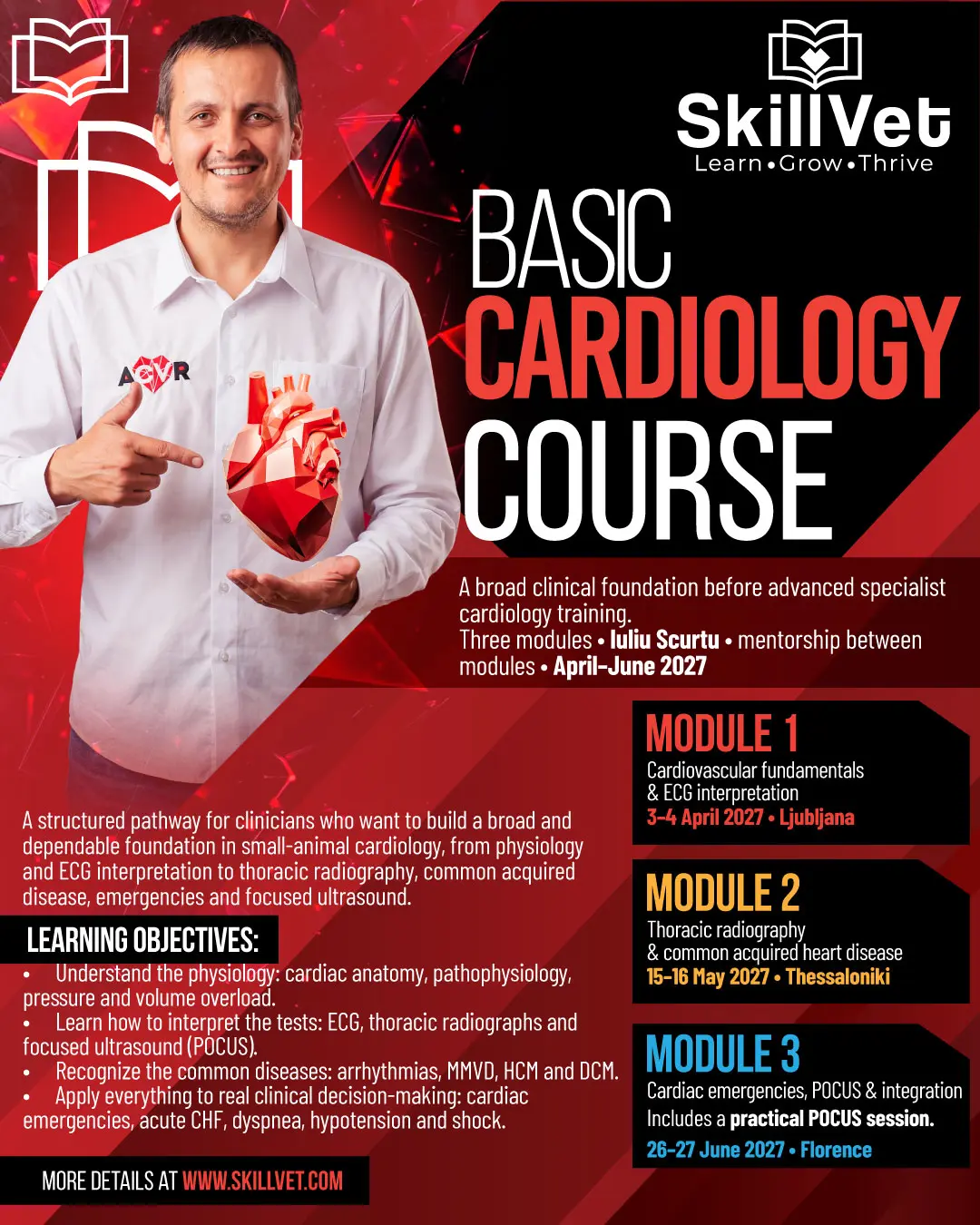
The Basic Cardiology Course is a three-module course with Prof. Dr. Iuliu Scurtu and mentorship between modules. It builds a broad and dependable foundation in small-animal cardiology, from physiology and ECG interpretation to thoracic radiography, common acquired disease, emergencies, and focused ultrasound.
Key facts
April 3–4, May 15–16, and June 26–27, 2027 · Ljubljana, Thessaloniki, and Florence, in person · Three modules, one instructor, mentorship between modules · Certificate of attendance · €1,995 early bird, €2,235 standard (all taxes included)
Program at a glance
Module 1:
Cardiovascular Fundamentals & ECG Interpretation
Foundations of Cardiovascular Medicine,
ECG Foundations, and Thoracic Assessment
Ljubljana, Slovenia — April 3–4, 2027
Anatomy, physiology, and pathophysiology, then the ECG: a systematic approach, common arrhythmias, and exercises that integrate rhythm findings with the clinical patient.
Module 2: Thoracic
Radiography & Common Acquired Heart Disease
Thoracic Radiography for the Cardiac
Patient and Common Acquired Cardiac Disease
Thessaloniki, Greece — May 15–16, 2027
Thoracic radiography for the cardiac patient, then the common acquired cardiac diseases: MMVD, hypertrophic cardiomyopathy, and dilated cardiomyopathy.
Module 3: Cardiac Emergencies, POCUS & Integration
Emergency Cardiology and Focused
Ultrasound, Practical POCUS session, Clinical Decision-Making, Assessment, and
Consolidation
Florence, Italy — June 26–27, 2027
Emergency cardiology and focused ultrasound, including a practical POCUS session, then clinical decision-making, a final knowledge assessment, and an integrated case discussion that puts the full course together.
Course description
How do you read an ECG and know what it means? What is the thoracic radiograph showing, and what only looks cardiac? Which acquired heart disease is it, and what is the initial plan? And when the patient is a cardiac emergency, what comes first in the first five minutes?
The Basic Cardiology Course is a structured three-module course designed to build a broad clinical cardiology foundation. It runs from April to June 2027 across three teaching weekends in Ljubljana, Thessaloniki, and Florence. It moves from cardiovascular fundamentals and ECG interpretation to thoracic radiography and common acquired heart disease, before integrating emergency assessment, POCUS, case-based decision-making, and a final knowledge assessment.
The course progresses step by step: understand the physiology, learn how to interpret the tests, recognize the common diseases, and then apply everything to real clinical decision-making. Prof. Dr. Iuliu Scurtu, who created the course, teaches all three modules, from the first anatomy session to the final case panel, and mentors you between modules, so the learning carries into your own clinical work.
Teaching philosophy
Clinical cardiology draws on several skills at once: understanding physiology, interpreting an ECG, reading a thoracic radiograph, recognizing disease, and making decisions when the patient is unstable. This course teaches them in sequence and then brings them together.
The course uses a spiral learning model. Core principles are introduced early, revisited, and applied with increasing complexity. Cardiovascular physiology and pathophysiology in Module 1 give you the language for reading the ECG, for interpreting thoracic radiographs in Module 2, and for assessing the emergency patient in Module 3. The course closes with a final knowledge assessment and an integrated case discussion that draw on ECG, radiography, disease, and emergency questions together.
The material is put to work throughout: ECG exercises in Module 1, a radiographic case workshop in Module 2, a POCUS practical session and rapid case-based decision-making in Module 3, and case discussions across the course.
The commitment throughout is clinical relevance: translating complex cardiology concepts into practical knowledge that can be applied in veterinary practice immediately.
Learning objectives
By the end of Module 1, participants will be able to:
- Apply core cardiac anatomy and physiology to everyday clinical cardiology cases
- Explain the consequences of pressure overload, volume overload, and reduced cardiac output
- Record a diagnostic-quality ECG and identify common artifacts
- Use a consistent step-by-step method to interpret an ECG
- Recognize common clinically important arrhythmias and place them in clinical context
Educational objectives
By the end of the full course, participants will be able to:
Module 1: Cardiovascular Fundamentals & ECG Interpretation
- Apply core cardiac anatomy and physiology to everyday clinical cardiology cases
- Explain the consequences of pressure overload, volume overload, and reduced cardiac output
- Record a diagnostic-quality ECG and identify common artifacts
- Use a consistent step-by-step method to interpret an ECG
- Recognize common clinically important arrhythmias and place them in clinical context
Module 2: Thoracic Radiography & Common Acquired Heart Disease
- Assess thoracic radiograph quality before interpreting cardiac and pulmonary findings
- Identify common patterns of cardiomegaly, pulmonary vascular change, and cardiogenic pulmonary edema
- Distinguish common cardiac radiographic findings from important non-cardiac mimics
- Describe a practical approach to MMVD, including staging and management principles
- Recognize the broad clinical features of HCM and DCM and formulate an appropriate initial plan
Module 3: Cardiac Emergencies, POCUS & Integration
- Prioritize immediate assessment and stabilization of common cardiac emergencies
- Use focused cardiac, pleural, and lung ultrasound to answer clinically relevant emergency questions
- Integrate physical examination, ECG, thoracic imaging, and POCUS findings
- Formulate an initial plan for acute CHF, dyspnea, hypotension, and shock
- Demonstrate consolidation of the knowledge taught across all three modules
Between-module mentorship
Learning in clinical cardiology does not stop when the weekend ends. Each participant in this course is mentored between modules by Prof. Dr. Iuliu Scurtu, Program Head and Lead Mentor, because practical improvement occurs when skills are applied repeatedly to real clinical material in the weeks that follow a module, not only during it.
Between modules, participants are encouraged to submit clinical cases, ECG recordings, thoracic radiographs, focused ultrasound images, and their own interpretation. Prof. Dr. Scurtu's feedback focuses on technical quality, systematic approach, description of findings, prioritization, differential diagnosis, and clinical recommendations.
The mentorship is designed to help participants recognize strengths and weaknesses in their own approach and develop a more disciplined method of interpretation. When clinically significant uncertainty is present, participants are guided toward referral or specialist review.
Participants may also take part in structured group discussions or one-to-one mentoring conversations to clarify concepts, work through difficult cases, prepare for the next module, and receive guidance on personal learning goals. This structure supports continuity and accountability between modules.
Evaluation and certification
The course includes a final knowledge assessment with feedback in Module 3, covering integrated ECG, radiography, disease, and emergency questions. Throughout the course, ECG exercises, the radiographic case workshop, case discussions, and between-module feedback give participants regular opportunities to check their understanding.
Participants who complete the course receive a certificate of attendance. The certificate reflects completion of a structured continuing education course; it does not imply specialist status or board certification. The European certificate is reserved for the separate five-weekend Advanced Cardiology Masterclass and requires successful completion of its final examination.
Instructional methods
The course combines several instructional methods, because clinical cardiology requires knowledge, interpretation, practical skill, and clinical judgment.
Lectures provide structured frameworks: the physiology and pathophysiology behind cardiac disease, a step-by-step method for interpreting an ECG, a systematic approach to thoracic radiographs, and the clinical approach to MMVD, HCM, DCM, and cardiac emergencies.
Exercises, workshops, and case discussions put the frameworks to work: ECG exercises in Module 1, a radiographic case workshop in Module 2, and rapid case-based decision-making, a final knowledge assessment, and an integrated case panel in Module 3. A POCUS practical session in Module 3 covers obtaining focused cardiac, pleural, and lung views.
Between-module mentorship activities include case submissions, interpretation exercises, and optional one-to-one support for participants with specific learning goals.
SkillVet is independent and vendor-neutral. This course does not depend on any specific ECG device, radiographic system, ultrasound machine, software platform, or commercial product. No manufacturer sponsorship determines the curriculum.
Faculty
Prof. Dr. Iuliu
Scurtu
Program Head and Lead Mentor
Professor of Veterinary Cardiology, USAMV Cluj-Napoca • Head of the Veterinary Cardiology Service • ECVIM-CA Cardiology Resident
You learn from a veterinary cardiologist who is Professor at USAMV Cluj-Napoca, leads its Veterinary Cardiology Service, and has trained in cardiology across Europe, including residency training at the Vetsuisse Faculty, University of Zurich.
Prof. Dr. Scurtu created the Basic Cardiology Course. As Program Head and Lead Mentor, he teaches all three modules and mentors participants throughout the course, including between modules.
Prof. Dr. Iuliu Scurtu is a veterinary cardiologist, educator, and researcher with over 20 years of experience in veterinary medicine. He is Professor at the University of Agricultural Sciences and Veterinary Medicine Cluj-Napoca (USAMV) and leads the institution's Veterinary Cardiology Service, combining clinical practice, teaching, and research.
A graduate of the Faculty of Veterinary Medicine, he completed his PhD at USAMV and has pursued advanced training in veterinary cardiology across Europe, including ESAVS programs, international externships, and residency training in cardiology at the Vetsuisse Faculty, University of Zurich.
He is the author of multiple textbooks and numerous peer-reviewed publications in veterinary cardiology and cardiovascular medicine. His clinical and research interests include echocardiography, electrocardiography, arrhythmias, congenital heart disease, and advanced cardiac imaging in companion animals.
He is a member of the European Society of Veterinary Cardiology and the Romanian Society of Veterinary Cardiology. His teaching philosophy emphasizes translating complex cardiology concepts into practical, clinically relevant knowledge that can be immediately applied in veterinary practice.
Is this program right for you?
This course is designed for clinicians who want to build a broad and dependable foundation in small-animal cardiology.
It is suitable for you if:
- You want to apply cardiac anatomy and physiology to everyday clinical cases
- You want a consistent, step-by-step method for interpreting an ECG
- You want a systematic approach to the thoracic radiographs of the cardiac patient
- You want a practical approach to common acquired heart disease: MMVD, HCM, and DCM
- You want to be ready for the cardiac emergency: first assessment, stabilization, and focused ultrasound
- You want continuity of learning, with one instructor and mentor across all three modules
- You want practical experience obtaining focused cardiac, pleural, and lung views
This course is a broad clinical foundation before advanced specialist cardiology training, and it is not intended as a substitute for it. For clinicians who later want to go further, the Advanced Cardiology Masterclass is a separate five-weekend advanced pathway with its own European certificate.
Conclusion
If you want a broad and dependable foundation in small-animal cardiology, this course is built for you: three modules in Ljubljana, Thessaloniki, and Florence, one instructor and mentor throughout, from the physiology of the heart to the first five minutes of a cardiac emergency.
Questions ? hello@skillvet.com
Registration fees
- Early bird: €1,995 (all taxes included) - until 31st of January 2027
- Standard: €2,235 (all taxes included) - after 1st of February 2027
What's included:
- Three in-person modules in Ljubljana, Thessaloniki, and Florence
- Mentorship between modules
- Access to theory lecture recordings
- The final knowledge assessment
- Your certificate of attendance
- Lunch, coffee, and water on both days of each module
Not included: accommodation, travel, and evening meals.
Installment plans are available for a maximum of four payments. To request a plan, email hello@skillvet.com.
Romanian VAT (21%) is legally required for all participants, regardless of country of origin or VAT registration status. This is a legal obligation under EU and Romanian tax law for in-person educational events; it cannot be waived or exempted.
FAQ
Registration covers the full three-module course. Individual modules are not available separately.
A certificate of attendance on completion. The European certificate is reserved for the separate five-weekend Advanced Cardiology Masterclass and requires successful completion of its final examination.
The Basic Cardiology Course is a broad clinical foundation before advanced specialist cardiology training. The Advanced Cardiology Masterclass is a separate five-weekend advanced pathway with its own European certificate. This course does not lead to the Masterclass certificate.
ECG interpretation is part of Module 1 of the Basic Cardiology Course, alongside cardiovascular fundamentals. The ECG Interpretation Weekend (January 30–31, 2027, Bucharest, with Kieran Borgeat) is a separate stand-alone weekend dedicated entirely to the ECG.
Module
3 includes a POCUS practical session on obtaining focused cardiac, pleural, and
lung views. Other sessions include ECG exercises, a radiographic case workshop,
and clinical case discussions.
In person, at three locations: Module 1 in Ljubljana, Slovenia (April 3–4, 2027), Module 2 in Thessaloniki, Greece (May 15–16, 2027), and Module 3 in Florence, Italy (June 26–27, 2027).
The registration fee covers all course materials, access to theory lecture recordings, lunch on both days of each module, coffee, and water. Accommodation, travel, and evening meals are not included.
English.
Participants who miss a module for reasons of force majeure receive access to the theory lecture recordings for that module. Practical skills from a missed Module 1 or Module 2 can be recovered during a subsequent module by arrangement. Module 3 is the final module, so its practical POCUS session cannot be made up later. Attendance at all three modules is expected; please contact us before registering if you have a known scheduling conflict.
No. However, everyone will receive a certificate of attendance.
Yes. Installment plans are available for a maximum of four payments. To request a plan, email hello@skillvet.com with the number of installments you need; the team will set up a payment schedule for you.
Yes.
Contact hello@skillvet.com.
Cancellations submitted more than 30 days before the course start date (April 3, 2027) are eligible for a full refund. Cancellations received within 30 days of the start date are not eligible for a refund. To cancel, contact hello@skillvet.com.
Accommodation,
flights, and evening meals are not included in the registration fee and are the
responsibility of each participant.
No scholarships are currently available.